For the past week or so there’s been a lot of finger pointing—most of it directed at Bessent and Lutnick—regarding who screwed up and got us into this rare earths mess with China. The finger pointers are saying that Bessent and Lutnick failed to listen to Chinese warnings and pushed ahead to massively escalate the trade war on China, even as negotiations were going on—a clear bad faith move. Unlike the US, China has been preparing for years, if not decades.
Select Committee on China @ChinaSelect
Oct 20
China has run the same playbook for decades—subsidies, unfair trade practices, and hollow promises. It’s time to revoke their “normal” trade status and impose strong tariffs on critical sectors. Free trade is for free nations, not the CCP.
Warwick Powell | 鲍韶山 @baoshaoshan·
Oct 21
The U.S. has run the same playbook for decades—war, military interventions, corporate welfare, rising social dysfunction, illegal sanctions … it’s time to revoke their Hegemon status.
Compare and contrast:
Bloomberg @business
China has spent two decades building a globe-spanning port network that offers it commercial reach and a strategic edge against rivals
Warwick Powell | 鲍韶山 @baoshaoshan
8h
And the US spent decades establishing and running globe-spanning military bases.
The US response to the discovery that China has a plan has been largely blustering outrage—in the face of an inability to force the world back into the mold of Anglo-Zionist hegemony:
Glenn @GlennLuk
“Indeed, a growing number of officials in Washington employ Cold War–style rhetoric when discussing China yet demonstrate little appetite to take on the difficult and expensive tasks, such as refurbishing the defense industrial base and shoring up key supply chains, that would help the United States outcompete China.
If this dynamic continues, the United States will be left pursuing what might be called a “Reverse Roosevelt” strategy: speaking loudly about American power while wielding an ever-smaller stick. While Xi has been disciplined and methodical in his efforts to bolster China’s strategic position, the United States has been distracted and incoherent. Misreading Xi Jinping is, ultimately, part of the failure to address the problems facing the United States itself.”
We even see the US trying to cast itself as the underdog fighting back against intimidation:
*Walter Bloomberg @DeItaone
GREER: CHINA TRYING TO DETER U.S. INVESTMENT
USTR Jamieson Greer accused China of pressuring foreign firms to avoid investing in key U.S. industries.
He said Beijing aims to disrupt supply chains and slow recovery, targeting shipbuilding and other vital sectors.
“Intimidation won’t stop us from rebuilding,” Greer said, pledging to protect U.S. companies and boost investment.
7:57 PM · Oct 20, 2025
It seems the Chinese have learned from the US—secondary sanctions for me but not for thee? “Trade wars are easy to win?”
Bloomberg @business
The Trump administration warned China not to retaliate against foreign companies helping the US to develop critical industries, after Beijing last week sanctioned the US units of a South Korean shipping giant
Just as bad, these complaints don’t seem to translate into constructive action and a real plan:
Patrick Muncaster @PatrikMuncaster
Oct 20
Trump is messing with supply chains all over the world and Greer accuses the Chinese of doing the same...that’s rich.  Meanwhile US executives are trying to keep their companies alive while Trump creates one supply chain uncertainty after another. What a gong show!
Warwick Powell | 鲍韶山 @baoshaoshan·
Oct 21
The U.S. needs to de-financialise before it can re-industrialise.
The elite are already setting the explanation for when it all falls flat. It’s “Chyna!”
As if—the ruling elite definancializing, when that’s what keeps them in their ruling position? It all translates into a lot of bluff and bluster without a lot of leverage. This is quite a long tweet, but highly important:
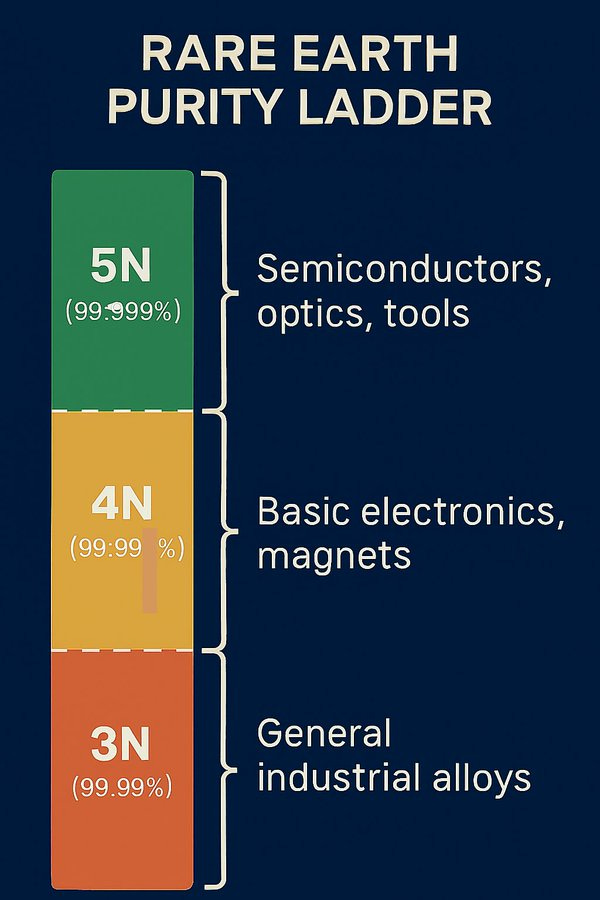
By any strategic measure, China’s grip on the rare earth supply chain is not just dominant—it’s nearly unassailable. With 83% of global rare earth refining capacity and 92% of the world’s magnet production, Beijing has built a fortress around one of the most critical inputs to modern technology. But it’s not just the volume—it’s the purity that defines the moat.
China is the only country that achieves 5N purity (99.999%) in rare earth refining. This ultra-high standard is not a luxury—it’s a necessity for the semiconductor and precision tool industries. At 3N or 4N purity, rare earth oxides may suffice for wind turbines or electric vehicles. But in the world of AI chips, EUV lithography, and atomic-scale etching, even trace impurities can sabotage performance, reliability, and yield.
The Semiconductor Dependency
…
In a world increasingly defined by technological sovereignty, the ability to refine rare earths to 5N purity is not just a technical achievement—it’s a strategic weapon.
Unless the U.S. can build a vertically integrated, environmentally sustainable, and purity-competitive rare earth ecosystem, it will remain dependent on China’s moat. And in the semiconductor arms race, dependency is vulnerability.
11:50 PM · Oct 21, 2025
That’s leverage.
So what went so wrong that Trump blithely walked right across a Chinese red line, leading China to go nuclear?
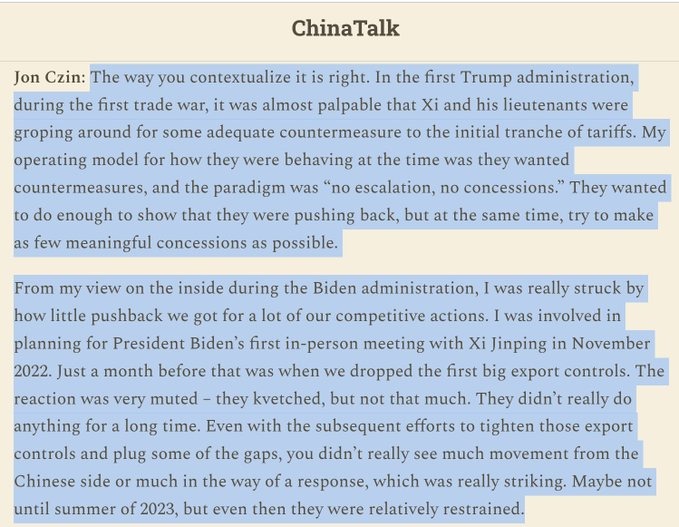
Apparently Trump thought the China he was dealing with in 2025 was the same China he dealt with in 2018, when he first unleashed tariff shock and awe on China. Top American officials had been surprised back then at how “restrained” the Chinese response had been:
Zichen Wang @ZichenWanghere
For anyone who needs evidence of how much restraint Beijing exercised amid wave after wave of trade escalations in the Trump 1 and Biden years, this is Exhibit A.
Even the U.S. government’s top China analyst was surprised by the Chinese restraint.
Literally.
11:53 AM · Oct 21, 2025
What Americans failed to understand is that the Chinese don’t typically go off half cocked:
Glenn @GlennLuk
21h
I think it was perhaps less restraint and just not being ready yet to respond the way it wanted because it just takes a lot of time and planning to roll out these measures.
Recall our discussion of the importance of helium, and the concerted Chinese drive to obtain a dominant position in that regard? That was triggered by Trump’s tariffs “back then.” Full tweet at link:
Arnaud Bertrand @RnaudBertrand
Here’s a question I know many are wondering about: why did China wait until now to use rare earths as leverage against the US? Why not in the first Trump administration when the US started the trade hostilities? Or when the Biden administration unleashed the chips export controls 3 years ago?
I just watched a fascinating explanation by a Chinese analyst and, unexpectedly, a big part of the explanation is... helium.
…
Yesterday I presented Chinese foreign minister Wang Yi’s blunt warning to the Trump regime. There was more to it than I realized, and Arnaud Bertrand’s explanation says a lot about China and about America’s lack of understanding of China. First, we present what triggered the Chinese nuclear response (referred to above):
Mathieu Duchâtel @mtdtl
A deep dive into the Entity List in US-China relations, and in US relations with Europe and Japan. 1,400 Chinese firms were on the list before the September 29 “Affiliate Rules”. After the rules, the count surged by roughly 20000.
Arnaud Bertrand @RnaudBertrand
This is the huge US escalation that decided China to roll out its rare earths export controls: in the end of September the Trump administration increased he number of Chinese companies on the “Entity List” by 14 times (!), from 1,400 to 20,000.
Meaning 14 times more Chinese companies cut off from the Western financial system, forbidden to use USD, etc. Including, of course, Nexperia in Holland, which is why the Dutch government seized the company away from China (to avoid these sanctions).
The Trump administration tried to present China’s move as something that came completely out of the blue and was uncalled for. But it came directly on the back of the largest expansion ever, by far, of US sanctions on China.
The poem Wang Yi cited in his response worth paying attention to. This is something we’re not exactly used to in the West (especially given the sheer crassness of the Trump administration) but senior Chinese officials love replying to question with references to classical poetry, which often carry layers of deeper meanings and references.
In this case, the line Wang Yi cited - “the green mountains cannot bar the river’s way; after all, it flows east” (”青山遮不住,毕竟东流去”) - is from the poem “Pusa Man: Written on the Wall at Zaokou, Jiangxi” (”菩萨蛮·书江西造口壁”) by famous Song Dynasty poet Xin Qiji.
Even at the time, the poem was eminently political in its meaning since Xin Qiji wrote it out of frustration of seeing Northern China occupied by the Jin Dynasty after the fall of the Northern Song. The “river flowing east” symbolizes the inexorable force of historical destiny - if a river is bound eastwards no mountain can stop it - and in this instance the poet meant that China is meant to eventually be reunified.
The modern meaning in Wang Yi’s usage is clear when he also says that “decoupling and severing ties will ultimately isolate oneself”: the mountains (US) think they can block the river (China), but the river will simply flow around them, leaving the mountains isolated and irrelevant.
In short the US believes it’s containing China, but Wang Yi suggests all it’s doing is actually containing itself.
China, in other words, is quietly confident in the path they’ve been following for decades. China exercises restraint in the face of provocation, not responding unless it’s fully prepared for anything that follows. But that means that, once the action is taken, foreign provocateurs may find it very difficult to persuade China to roll back its policy—which has usually been years in the preparation—without major strategic concessions to China.
We’re definitely living in interesting times.
Thanks for reading Meaning In History! Subscribe for free to receive new posts and support my work.
Vance, who has voyaged to Israel, is referring questions about Gaza reconstruction policy to Jared Kushner. Still can't get over how certain people duped themselves into believing Kushner would have no role in the Second Trump Administration. It's arguably bigger than last time!

Michael Tracey @mtracey
3h
"If elected I will demolish the White House" -- would've been an interesting campaign pledge

Senator Rand Paul @SenRandPaul
19h
We don’t blow up boats off Miami because 25% of the time suspicion is wrong.
We shouldn’t do it off Venezuela either. These are small outboards with no fentanyl and no path to Florida.
We can’t just kill indiscriminately because we are not at war. It’s summary execution!
Everyone gets a trial because sometimes, the system gets it wrong. Even the worst of the worst in our country get due process.
The bottom line is that execution without process is not justice, and blowing up foreign ships is a recipe for chaos.
Michael Tracey @mtracey
2h
Vance, who has voyaged to Israel, is referring questions about Gaza reconstruction policy to Jared Kushner. Still can't get over how certain people duped themselves into believing Kushner would have no role in the Second Trump Administration. It's arguably bigger than last time!

Michael Tracey @mtracey
3h
"If elected I will demolish the White House" -- would've been an interesting campaign pledge