
I want to recommend a reading of Alastair Crooke’s new article:
Basically, Crooke is pondering the reasons for the irrational world events we see unfolding—the divorce of Western man from reality, which has turned the world upside down. Trump is simply a manifestation of this more general problem. To give you an idea of what spurred Crooke’s reflections, he begins by recalling a 1910 book by Norman Angell. Angell was a prominent public figure in pre-WW1 England, who even received the Nobel for his efforts for world peace. His book was The Great Illusion. In it Angell argued that
“the economic cost of war was so great that no one could possibly hope to gain by starting a war the consequences of which would be so disastrous.” For that reason, a general European war was very unlikely to start, and if it did, it would not last long.[6] He argued that war was economically and socially irrational and that war between industrial countries was futile because conquest did not pay. J. D. B. Miller writes: “The ‘Great Illusion’ was that nations gained by armed confrontation, militarism, war, or conquest.”
Fast forward to today. Angell’s thesis has proven to be, well, illusory. Multiple times.
Now, Crooke’s argument appears to be that the “Enlightenment project” cut Western man off from traditional ways of thinking that have been preserved in “civilizational” societies—for example, Russia, China, Iran. He enlists the late, great Thomist philosopher, Alasdair MacIntyre, in support of his argument, citing MacIntyre’s first major work in a series of works that attempted to offer both an explanation and a solution to the moral chaos of the West: After Virtue.
MacIntyre’s argument is that it is cultural tradition alone, and its moral tales, that provide context to terms such as good, justice and telos [the end or goal toward which, “final ends”]:
“In the absence of traditions, moral debate is out of joint and becomes a theatre of illusions in which simple indignation and mere protest occupy centre stage”.
Crooke argues that, in the absence of tradition, moral debate may be heated but it’s incapable of hearing “the Other”—precisely those still traditional, civilizational, societies that live outside the Enlightenment world and project.
all moral judgments – stripped of context [that tradition provides] – become little more than expressions of preference, of attitude or feeling -- emotivism, in other words -- debate is out of joint; it is transformed into a theatre of narratives in which indignation and polarity take centre stage.
Russia, China, Iran all become invisible to Enlightenment man. Enlightenment man by his nature is forbidden to recognize traditional man or to question his own stance—a position that Marx made explicit. Indeed, the Other becomes a threat that must be eradicated. War is made possible, even likely.
Now, I’ve expanded on Crooke’s argument a bit, but I believe not unfairly. It so happens that these issues are those that I had originally intended to move on to in Meaning And History—until my past life intruded in the form of the Russia Hoax and then the Anglo-Zionist war on the world. For readers who have not gone through the older Meaning And History, I should explain that I share with MacIntyre a Thomist intellectual formation. Indeed, MacIntyre, in his 1990 Aquinas Lecture (First Principles, Final Ends and Contemporary Philosophical Issues) cites me and my translation of Etienne Gilson’s Thomist Realism and The Critique of Knowledge. So I’d like to expand on all this a bit, because it is crucially important.
It’s important to understand that MacIntyre’s understanding of the term “traditional” is not exactly what is called to mind for most people in the modern West. Perhaps a good way to start would be by reference to the title of MacIntyre’s first major work: After Virtue. What MacIntyre is referring to is the demise of virtue based morality in the West. “Virtue” refers to those qualities that make a man to be really or fully Man. The epitome of virtue morality is the thought of Aristotle, whose moral theory was based on the four Cardinal Virtues: prudence, justice, fortitude, and temperance. These cardinal virtues were absorbed into Christian thought and were supplemented by the three Theological Virtues: faith, hope, and love/charity. How did virtue morality fail in the West?
In traditional societies—what Mircea Eliade terms the societies of “archaic man” (please search on Mircea Eliade at this substack)—it is accepted that the cosmos, reality as we know it, is what it is and is knowable as such by Man. We know the cosmos as an ordered system of being. We are able to know the nature of the beings within that order and the order of or societies is intended to mirror the cosmic/divine order and its purpose—which is to say, the telos, the end, the goal. Ultimately, the meaning of it all. Religious rites are intended to participate in that order in a special way. This is the worldview on which Aristotle’s virtue morality is based. We can know Man’s nature and the traits that a man needs to develop to be fully Man. The development of that nature is the purpose of human life. This worldview was passed on in great part to the world of Christianity. For an accessible read on that topic—which plays very much into this passage by Crooke:
A recovery of older ways of thinking -- the ‘all-at-once, all together’ way of thinking (thinking through image) and other sources of cognition -- can open a path to mediation between the seemingly oppositional polarities of the subjective and the objective which mechanical rationality so often leaves hardened into unresolvable impedimenta.
see: Chesterton’s Thomist View of Myth.
OK. The way in which the link between reality and human insight into reality was broken is a long story, but that rupture is what ipso facto brought about the demise of virtue morality.
The story—which must be kept short—begins with Aristotle’s mentor, Plato. As I have argued in the past, Plato’s thought represents a radical ideologization of archaic Man’s “traditional” view of the cosmos. Plato’s “myths” (The Myth of the Cave, The Myth of Anamnesis) represents attempts to provide a radically rational account of Man’s insight into reality, his knowledge of the natures of things. The result was a strong tendency toward a radical skepticism that has bedeviled the West for over 2000 years. Plato attempted to solve the conundrum of the One and the Many (inherited from Parmenides) by appealing to his Myth of Anamnesis—recollection of Idea/Forms/Natures from a previous life. This was pretty obviously a non-starter as solutions go.
Augustine—the fons et origo of virtually all Western philosophy—offered a literally Deus ex machina solution. For those readers who are not aware of Augustine’s overwhelming influence, I urge, even beg, you to read my earlier post:
David Knowles begins his chapter on St. Augustine in The Evolution of Medieval Thought by noting Augustine’s almost overwhelming influence not only on Medieval thought but on all Western Christendom. In fact, Knowles’ judgment could, and should, be extended to Western thought as a whole in many important respects:
St Augustine, it would be generally agreed, has had a greater influence upon the history of dogma and upon religious thought and sentiment in Western Christendom than any other writer outside the canon of Scripture. (29)
Even in this day, Augustine’s influence remains paramount in the West. For example, in the Catechism of the Catholic Church it is Augustine and not Thomas Aquinas who is--with the exception of Scripture--the most frequently cited authority. Nor is Augustine’s influence confined to religion, for the roots of most of our political and philosophical ideas in the West can be found in the various attempts to resolve the problems that Augustine bequeathed us and the implications of his thought.
Thus, almost immediately after he notes Augustine’s great influence, Knowles goes on to point out what may appear at first to be a paradoxical “dark side” to Augustine’s influence:
Yet, strangely enough, there is an obverse to this brilliant medallion. If Augustine was a second Bible to the dark and middle ages, he was all but the gospel of the three great heresies, Lutheranism, Calvinism and Jansenism, that absorbed so much of the mental activity of the sixteenth and seventeenth centuries...
Again, I’ll quote myself, from Anselm’s Platonism and the Development of Doctrine:
Man, says Plato, upon the occasion of sense knowledge recollects the archetypes (or “Forms/Ideas”) which he had known in a prior life before his soul was inserted into a body; these ideas are true reality, and the “recollection” of these ideas Plato compares to the perception of shadows on the wall of a cave cast by the unseen but true realities. This “doctrine” was “Christianized” by Augustine in his doctrine of Divine Illumination, which David Knowles correctly states “alone guarded an Augustinian from a general skepticism when the pure Platonic doctrine of ideas [known through anamnesis ] had gone.” Curiously, [Josef] Pieper doesn't mention Kant in his catalog of Western Platonists, for Kant's categories of thought are the prime example of secularized Platonism, the secular transformation of Plato's doctrine of Ideas.
Kant, of course, was reacting to the late medieval nominalist scholastic thinkers who flatly stated that Man has no knowledge of the nature of things and that, as a result, all morality is arbitrary. This is the logical consequence of all Platonisms and Kant’s effort to patch it up by claiming the the Mind imposes “categories” on a reality that we don’t even know exists only makes matters worse. Kant is the culmination of the entire Augustinian tradition of Platonism and his successors—Hegel, Heidegger, etc.—all follow in the line of those thinkers of both the Classical Liberal Right and the Marxist Left for whom order is imposed by Man as by a god. Think: Rules based order. But it’s also the source of Marxist thinking. Virtue morality is dead in the West—at least on the official, public level. Even the new Conciliar Church, built on the thought of Hegelians and such, has embraced the new liberal order. The result of this radical skepticism, as Crooke does hint, is that every human being is a atomized subject unto himself, radically individual. For the radical individual, Power is being. Trump is the ultimate modern man, in that sense.
I hope you’re still with me. MacIntyre’s After Virtue is all about that lamentable history, but MacIntyre is not part of that crowd. That’s the meaning of his Aquinas Lecture: First Principles, Final Ends and Contemporary Philosophical Issues. That title, for those with a background in Thomist thinking, is a dead giveaway that MacIntyre, following Gilson, holds that Man has direct insight into the first principles of being and is capable of understanding the nature of things. Within human limits, but it’s real knowledge of reality, not an illusion imposed by our subjective minds. But for a really deep dive into this history I recommend the third of MacIntyre’s books, Three Rival Versions of Moral Enquiry: Encyclopaedia, Genealogy And Tradition. It’s tough sledding, but here you’ll see his evaluation of the role of the Augustinian tradition in conflict with the Thomist tradition. Here’s the TOC:
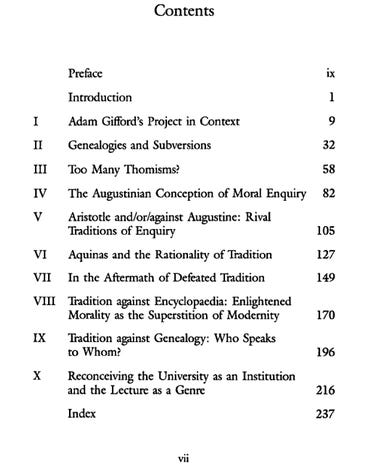
But all this history is also what at least some in the so-called civilizational societies are reacting against, even as the Post Christian West seeks to eradicate all traces of contact with real human nature. I’ll pivot back to Crooke for this:
‘Others’, then, whether Russia, Iran or China, simply become invisible by the norms of this approach -- as their ways of orienting human attention to the world are quite distinct.
Thus, we can (and are) being led to war by narrative messaging specifically intended to compel humans to spatialise the world in a certain way, without our being aware of it. We are being led to an Enlightenment-driven ‘one world’ in which all ‘Otherness’ -- whether Russian, Iranian or Chinese -- becomes invisible by the norms, the mode of presence, by which we approach ‘things’.
In this ‘war’, the world is turned ‘upside down’. ... Narratives are kneaded and rolled out before our eyes. This is how the machine works. Most people in the West believe themselves to have a firm handle on reality -- facts, evidence, and conclusions. But effectively, we face a structure that purposefully turns that imagined grasp on reality inside out.
…
So how can sovereign civilisations escape the ‘MacIntyre trap’? Can civilisations pull together the fragments of older insights and knowing to give the context by which to make moral discourse intelligible again?
Now, this is where MacIntyre’s understanding of “tradition” comes in. MacIntyre’s concern is that without a nurturing tradition—that is, nurtured in human, societal institutions of learning—what is left of the West could be doomed. MacIntyre, of course, was an academic, and so he naturally worried over the state of Western universities. Is it possible to rebuild from scratch, as if in a new Dark Ages? That passage from Crooke reminded me of something I wrote in May, 2022 (Catching Up: Covid, Liberalism):
The Founding Fathers didn’t talk about a constitution for a “values oriented” people. They spoke of virtue, because that’s the world they still lived in. Does this suggest why our constitutional order seems to have irretrievably broken down? Regaining an understanding of reality based on intelligent insight rather than emotion, preference, WILL, is not the work of a single generation, just as its devolution has not been the work of a single generation.
Who will pass it down, hand it on? That’s the meaning of “tradition.”
A few more words, if I may. Russia, China, Iran. All three of these countries have had sad experience with the secular descendants of Augustine, usually in the form of German ideologies: the thought of Kant, Hegel, Marx, often through the medium of radical secular Jews. Of course we know about the Bolsheviks in Russia, and the determined efforts to eradicate Christianity, Putin is seeking in Orthodoxy some spiritual rebirth for the Russian nation but, as I wrote back in 2022: Recovery is not the work of a single generation. The question is whether philosophy in Russia has the intellectual depth that will be needed to accomplish this task.
Likewise, we see the tragic consequences of Bolshevism in China, although few are aware of what Brave AI recounts:
Jewish individuals played a disproportionately visible role in the ideological, media, and diplomatic aspects of the Chinese Communist Revolution, though they did not constitute the majority of foreign support. Historical research confirms that while Soviet advisors provided critical military and logistical aid, Jewish intellectuals and activists were instrumental in shaping the Communist Party of China’s (CCP) international narrative and propaganda efforts.
Key Figures and Contributions
Prominent Jewish figures who contributed to the CCP’s rise and subsequent governance include:
Sidney Rittenberg: An American-born Jew who became a key translator and propagandist for Mao Zedong, helping to shape the CCP’s image in the West.
Israel Epstein: A Polish-born Jewish journalist who became a Chinese citizen and served as Mao’s Minister of Appropriations (Finance), playing a major role in China Reconstructs magazine.
Grigori Voitinsky and M.N. Borodin: Jewish Comintern agents who were instrumental in establishing the CCP and bridging communist ideology with Chinese nationalism in the 1920s.
Rewi Alley: Although not Jewish, this New Zealand activist worked closely with Jewish figures and contributed to the CCP’s industrial and cultural initiatives.
As in Russia, Xi is seeking a spiritual rebirth for China in Chinese tradition, against the spiritual depredations of the Anglo-Zionist West.
Iran? You think I’m kidding, right?
Jewish intellectuals and students played a significant role in the leftist opposition to the Pahlavi monarchy, primarily through participation in the Tudeh Party and the formation of the Association of Jewish Iranian Intellectuals (AJII).
But the Iranian situation is complex, and prediction has no place here. Unlike some branches of Sunni Islam, Shia Islam has a tradition of philosophical inquiry that goes back to the very beginnings. The influence of Neoplatonism is strong—Avicenna/Ibn Sina was a Persian Neoplatonist. We have seen that the influence of Kantian thinking is strong today, including among leading clerics. We’ve seen the fruits of Kantian thought in the West:
The reception of Immanuel Kant‘s philosophy in Iran represents a significant and multifaceted engagement with European thought, serving as a primary vehicle for introducing critical rationalism, liberalism, and modern epistemology into Iranian intellectual discourse. This influence spans diverse ideological camps, from religious intellectuals advocating for the reconciliation of Islam and democracy to state officials utilizing Kantian logic for geopolitical arguments.
Key Areas of Influence:
Religious Intellectualism: Thinkers like Abdolkarim Soroush have integrated Kantian concepts to argue that knowledge of transcendent reality is perceived rather than absolute, using this to support religious pluralism and democratic reform within an Islamic framework.
Political and Security Discourse: Prominent figures such as Ali Larijani, a former parliamentary speaker and IRGC commander with a PhD on Kant’s philosophy of mathematics, have applied Kantian distinctions (e.g., phenomenon vs. noumenon) to challenge Western universalist claims, framing Iran’s nuclear rights as independent of Western institutional recognition.
Academic and Philosophical Debate: Iranian scholars, including Mehdi Ha’eri Yazdi and Allameh Tabatabai, have critically engaged with Kant’s critique of the ontological proof for God’s existence and his theory of innate knowledge, often contrasting his ideas with classical Islamic philosophers like Avicenna and Mulla Sadra.
Liberal and Reformist Movements: Kantian ideas of autonomy and universal ethics have influenced younger generations of Iranian intellectuals and protest movements, providing a philosophical foundation for democratic consciousness-building distinct from authoritarian traditions.
Overall, Kant is one of the most widely read Western philosophers in Iran, with his works debated across a broad spectrum of political and religious groups, even by those who oppose his model of critical rationalism.
The archives are linked at the top of the home page:
https://meaninginhistory.substack.com/p/admin-the-earlier-meaning-in-history
Mark,
I am in awe of your writings and depth and breadth of knowledge. Thank you for sharing and enlightening us with this superb substack.
I have been a dedicated reader since .the Russia Hoax/ Covid days.
My worldview and sense of history, has changed so much through your writing and the many commenters on this site.
Thank you