MOAB—the Mother Of All Bubbles. In other words, the AI bubble. Everybody talks about it, but what’s its significance? Obviously, in the best of times—financial, economic, political, geopolitical—a bubble of the size we’re looking at would be problematic. But these are not the best of times. Thus, what would in the best of times still be disastrous in financial terms could turn out to be catastrophic in geopolitical terms. The reason why this is so is because the AI bubble is all that is preserving the appearance of US economic health—and, thus, of global influence. Add the context of disastrous Iranian sanctions on the Anglo-Zionist sphere leading up to the American midterm elections—in which Trump is expected to lose control over at least the House and very likely the Senate. We are probably looking at turmoil on all fronts following the midterms: financial, economic, political, geopolitical.
Today the WSJ is reporting on warnings from Ken Griffin, who basically isCitadel. PP provides the short story part:
Philip Pilkington @philippilk
4h
Griffin said it: they went way overboard building AI hardware. Now they’re going to have to ask where the demand will come from.
Here’s a bit longer version with more detail on Griffin’s longer term views:
The Kobeissi Letter @KobeissiLetter
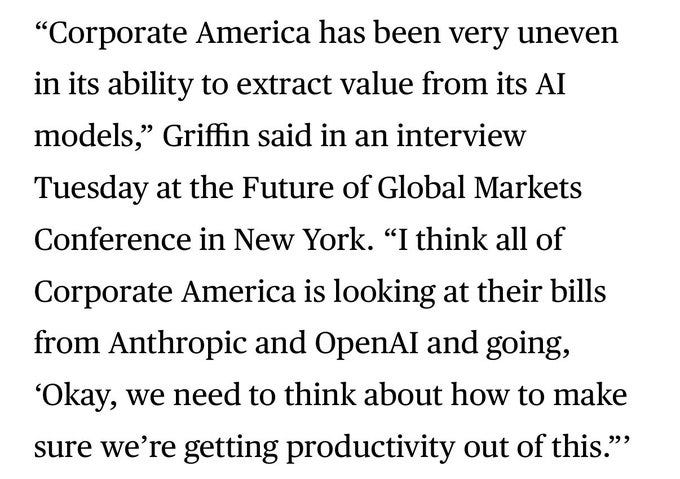
BREAKING: Citadel founder Ken Griffin says AI is “almost certainly” a bubble, noting that companies are struggling to turn AI spending into productivity gains.
However, Griffin says he is bullish on AI’s long-term potential.
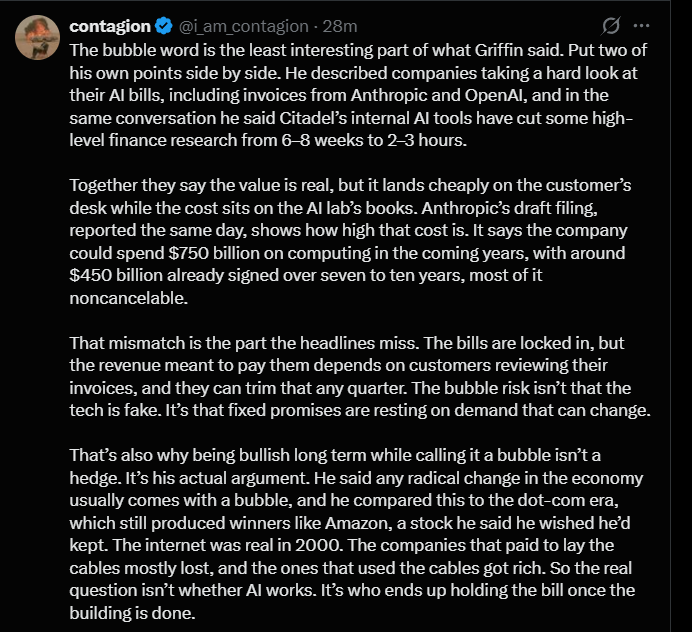
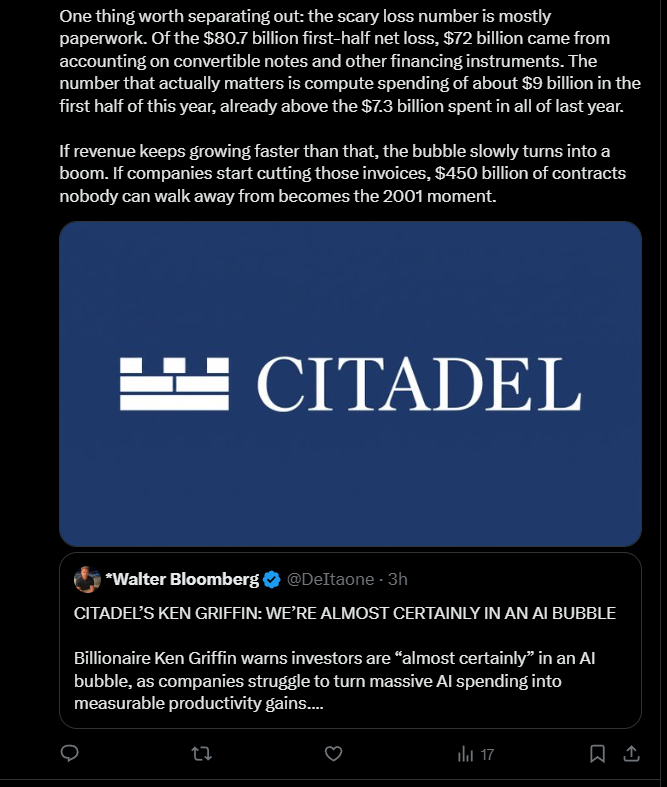
contagion @i_am_contagion
8h
The full story of what Griffin meant
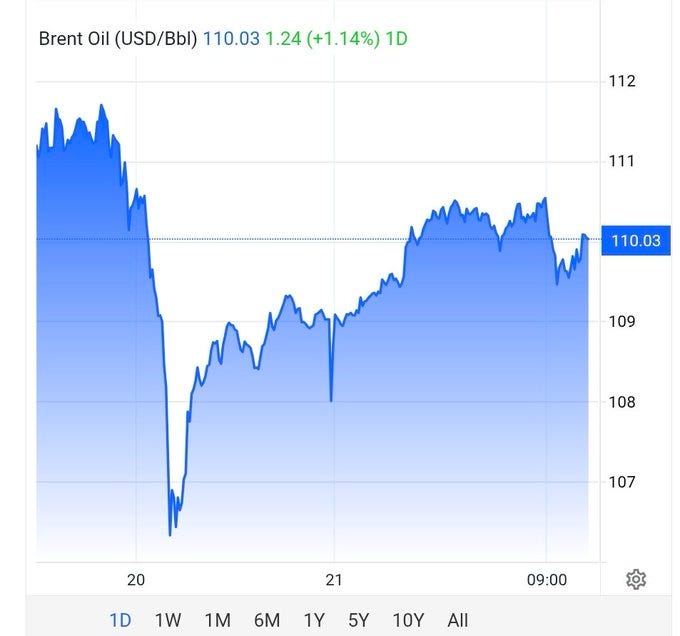
That’s fine for Ken Griffin, but Trump isn’t living in the long term at this point. Count on it—Moscow, Beijing, and Tehran understand the importance of all this, and they’re cutting Trump no slack. And Trump did this to himself by demonstrating, repeatedly, that he is deal incapable. His word means nothing. All three of those governments would be happy to get along with America on a cooperative basis, but Trump—the pawn of Jewish nationalists—has made that impossible. Moscow and Beijing could conceivably talk Tehran into some sort of a face saving deal for Trump, but they fear that Trump would turn around, break his word once again, and attack their strategic interests. The result is that the AI bubble is being leveraged against Trump along with the related energy crisis. The bond markets are a measure for what’s happening on the world stage.
That’s the bad news. There is no good news. For example:
Philip Pilkington @philippilk
19h
Smash that “oh shit” button, frens.
The Kobeissi Letter @KobeissiLetter
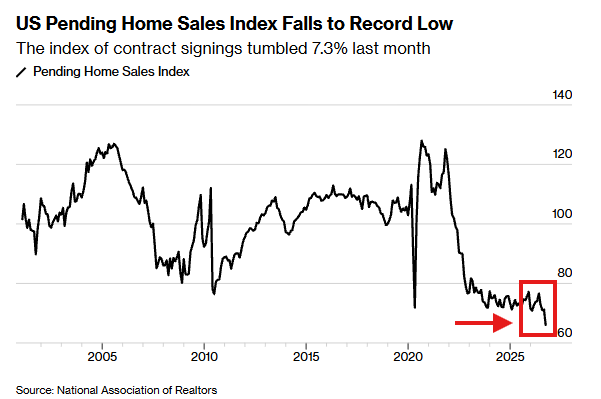
BREAKING: US Pending Homes Sales collapsed -7.3% in September, to their lowest level on record in data going back to 2001.
The West saw the steepest decline of -9.2%, while sales in the South, the biggest home-selling region, fell -8.2%.
The housing market is frozen.
2001? That was a quarter century ago. Put another way, that was a generation ago. The manipulation levers aren’t working any longer:
MenchOsint @MenchOsint
Markets are not falling for this type of fabricated news anymore
Now, also tied into all this …
PP has a pretty smart article today at The American Conservative. We’ve been hearing rumors of a Russia Hoax Redux after the midterms. PP offers a smart take on that. I will add this. I agree that, as presented by PP, this looks like a losing proposition—Americans are fed up with these Jewish Nationalist wars and they know that the original Russia Hoax was pure BS. However, what else might be at play here? By seeking impeachment based on a hoax, the Dems could be hoping to satisfy their base—while avoiding the explosive details behind Trump’s presidencies that are associated with the Epstein files and Trump’s close ties to Jewish Nationalists. While also preserving the policy basis—as PP argues—for the continued war on Russia. Read it all, but here are some excerpts:
The people behind Russiagate were frustrated with the realist foreign policy being pursued in Europe by the likes of President Barack Obama and former German Chancellor Angela Merkel. “Obviously,” Obama said in March 2014 after the Russian annexation of Crimea, “we do not need to trigger an actual war with Russia. The Ukrainians don’t want that. Nobody would want that.”
But Obama was wrong: Some people very much wanted that [war with Russia], including his own former Secretary of State Hilary Clinton. And to get their confrontation, they first needed to build a core base of support.
The Clinton campaign could have chosen any number of issues on which to attack Trump in 2016. With the benefit of hindsight—and, as Trump recently blurted out, “over a million [Ukrainians] killed”—it is now clear why they chose the Steele dossier. Russiagate may have been a flop legally; its basic disconnection from reality made it a nonstarter in the courts. But as a propaganda piece it was an enormous success.
…
Well, it is starting to look like there is an effort underway to summon the ghost of Russiagate before the midterms in November. It started in the same city out of which the Steele dossier emerged: London. …
Unfortunately, PP lapses into code-speak. When he talks about “London” and “Israelis” and “pro-Israel voices” what he really means is: Jewish Nationalists.
The Israelis are getting in on the act too. In recent months, there has been a notable tendency of pro-Israel voices online to blame Russia for a variety of problems. Laura Loomer’s recent Damascene conversion is a case in point: …
Why would Jewish Nationalists turn on Trump, their best, er, pawn? Because of his willingness to adopt the realist idea of seeking Russian support for the longer term war on China. Jewish Nationalists understand the threat China poses to their financial hegemony, but they can’t let go of their desire for revenge against Russia. They want their cake and they want to eat it, too. Revenge on Russia can be the prelude to subjugating China once again. But, in a judo-like way, a Russia Hoax Redux could save Trump from the much greater danger of a deep dive into the full meaning of the Epstein files. Trump would limp through his final two years, but the greater cause would be preserved.
But can a new Russiagate build the same momentum as the original? Probably not; politics, especially in America, rewards novelty. Yet rehashing the issue may nonetheless help Democrats somewhat, especially given the change in America’s geopolitical position since 2016.
Help the Dems? I don’t think that would be the real point.
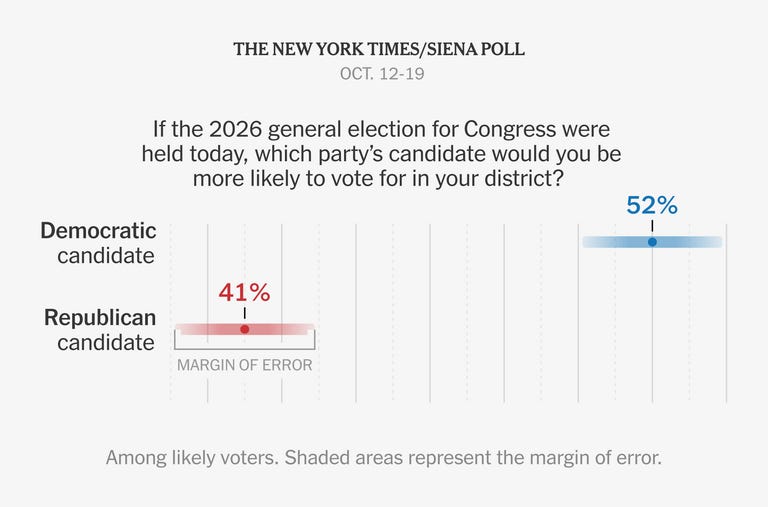
Just 36 percent of likely voters said that they approved of President Trump’s performance, while 59 percent said that they disapproved, a New York Times/Siena poll found.
Thanks for reading Meaning In History! Subscribe for free to receive new posts and support my work.
The Bank for International Settlements has something to say about this arrangement:
They call it endogenous demand.
“When a chip maker or cloud provider finances a model developer or data-center operator that then buys its products, the supplier’s revenue growth reflects its own capital deployment as much as (or more than) independent customer demand. This obscures how much of the “boom” is organic versus self-reinforcing.” - My paraphrasing part of their recent bulletin on circular AI financing

Marandi with Judge Nap well worth a listen today. Toward the end he gets into the Dem/GOPer dynamic--and why it makes no difference to Iran.
Edward Dowd @DowdEdward
13h
The Bank for International Settlements has something to say about this arrangement:
They call it endogenous demand.
“When a chip maker or cloud provider finances a model developer or data-center operator that then buys its products, the supplier’s revenue growth reflects its own capital deployment as much as (or more than) independent customer demand. This obscures how much of the “boom” is organic versus self-reinforcing.” - My paraphrasing part of their recent bulletin on circular AI financing